For the better part of the last decade, venture capital rewarded a particular kind of founder. One with a compelling vision, a large addressable market, and a pitch deck that projected the future with confidence. Revenue helped, but momentum mattered more. Growth rates mattered more than margins. The story mattered as much as the numbers.
That market is gone. And in our view, what has replaced it is something healthier.
What the Data Actually Shows
SVB’s State of the Markets H1 2026 report, drawing on panel commentary from managing partners at Insight Partners, Union Square Ventures, and Lerer Hippeau, puts the shift in stark terms. Seed-stage companies raising in 2025 showed 322% year-over-year revenue growth on average — a number that sounds impressive until you compare it to 2021, when that figure was 959%. The difference is not a sign of weakness. Seed companies today are raising off a median revenue base of $363K versus $156K in 2021. More revenue. Slower relative growth. Much higher absolute expectations (SVB State of the Markets H1 2026).
The graduation rate from Series A to Series B within 24 months now sits at 13%, down from an estimated 20% in the 2021 era. And AI valuation premiums over non-AI businesses have reached 222% at Series D and beyond, with triple-digit premiums persisting even at earlier stages.
The chart below captures what this looks like in practice.
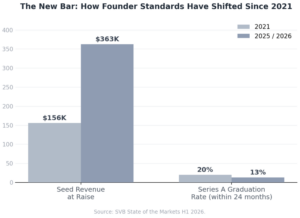
The translation, as SVB puts it plainly: slower growth, more revenue, much higher expectations — and ironically, healthier fundamentals than the frothy days of 2021.
Why This Is Good News for Founders Who Are Ready
We understand why founders read these numbers with caution. A tighter funnel, higher revenue expectations at raise, and a graduation rate that has compressed — none of that sounds like a welcoming market on the surface.
But we think the framing matters enormously. The 2021 market was not generous. It was indiscriminate. Capital went to companies that looked right on a slide, and many of those companies ultimately could not build durable businesses. The repricing that followed was painful precisely because so much had been funded on promise rather than proof.
The market of 2026 is asking harder questions earlier. That is a feature, not a bug. Founders who can answer those questions — who have real customer demand, repeatable unit economics, and a credible path to the next milestone — are finding that capital is available and moving. The selectivity is not a wall. It is a filter, and the companies getting through it are being built on stronger foundations.
Ben Lerer of Lerer Hippeau put it well: with capital increasingly chasing a small number of very large, consensus opportunities, early-stage investors have more breathing room, clearer lanes, and better opportunities to build meaningful stakes in exceptional companies. The signal-to-noise ratio at the early stage is improving (SVB State of the Markets H1 2026).
The Bar Is Higher Because the Opportunity Is Larger
One of the most important things to understand about the current market is that the higher standard is not arbitrary. It reflects a genuine shift in what is possible.
George Mathew of Insight Partners framed it this way: the current cycle of capital has built out the infrastructure that was necessary. The scaffolding is now in place. What comes next — vertical systems, vertical automations, applications that look nothing like what we have known — will be built by the founders who understand how to operate in a more disciplined environment.
This is worth sitting with. The infrastructure era of AI is largely complete. What follows is the application era, where the companies that win will win on execution, specificity, and genuine customer value — not on proximity to the technology itself. That is a market where proof matters more than promise, and where founders who have done the hard work of building real businesses will have a structural advantage.
For context on how platform shifts have played out historically: home internet crossed 50% adoption in 1999, but e-commerce as a category did not fully mature until roughly eight years later. Adoption, innovation, and monetization rarely move in lockstep. But they do eventually converge. The founders building today are early in that convergence, not late.
What Investors Are Actually Looking For
The question we hear most often from founders preparing to raise in H2 2026 is some version of: what does an investor want to see right now?
The honest answer is that it depends on stage, but the common thread across all of them is evidence of real demand. Not a pilot. Not a letter of intent. A customer who has paid, renewed, or expanded — someone who found the product so valuable that they chose to keep using it.
Beyond that, the market is rewarding founders who can demonstrate clear unit economics, a defensible position in their category, and governance that reflects the kind of company they intend to build. Clean cap tables. Clean contracts. A board that is working.
These are not extraordinary requirements. They are the fundamentals that have always distinguished great companies from good ones. What has changed is that investors are now asking for them earlier in the process and with less tolerance for the “we’ll figure it out at scale” answer.
Our View
We are genuinely optimistic about the second half of 2026 for founders who are prepared.
The 67% of US venture dollars that flow outside the top 1% of companies by valuation represents a substantial and underserved opportunity. Liquidity is returning — exit value nearly doubled year-over-year in 2025, and the IPO pipeline heading into H2 is the strongest it has been since 2021 (Fidelity Private Shares, 2026 VC Trends Report). LP sentiment is improving as distributions return.
The market is not asking founders to be perfect. It is asking them to be real. To show evidence of something working, not just evidence of something interesting.
For founders who have done that work, we believe the second half of 2026 offers one of the cleaner fundraising environments this decade has produced. The bar is higher. The competition for each dollar is more focused. And the investors who are writing checks are doing so with conviction rather than FOMO.
That is the kind of market where great companies get built.
About Fidelman & Company
Fidelman & Company is a boutique investment bank advising high-growth technology companies, emerging managers, and institutional investors on venture capital fundraising, strategic transactions, and liquidity solutions. The firm specializes in venture fund formation, LP fundraising, Series A and growth-stage capital raises, secondary advisory, and founder-focused outcomes. With deep expertise across both company and fund fundraising, Fidelman & Company helps clients navigate today’s evolving private capital markets.
Planning a raise in H2 2026? Contact us to help align timing, materials, and outreach with what’s working now.